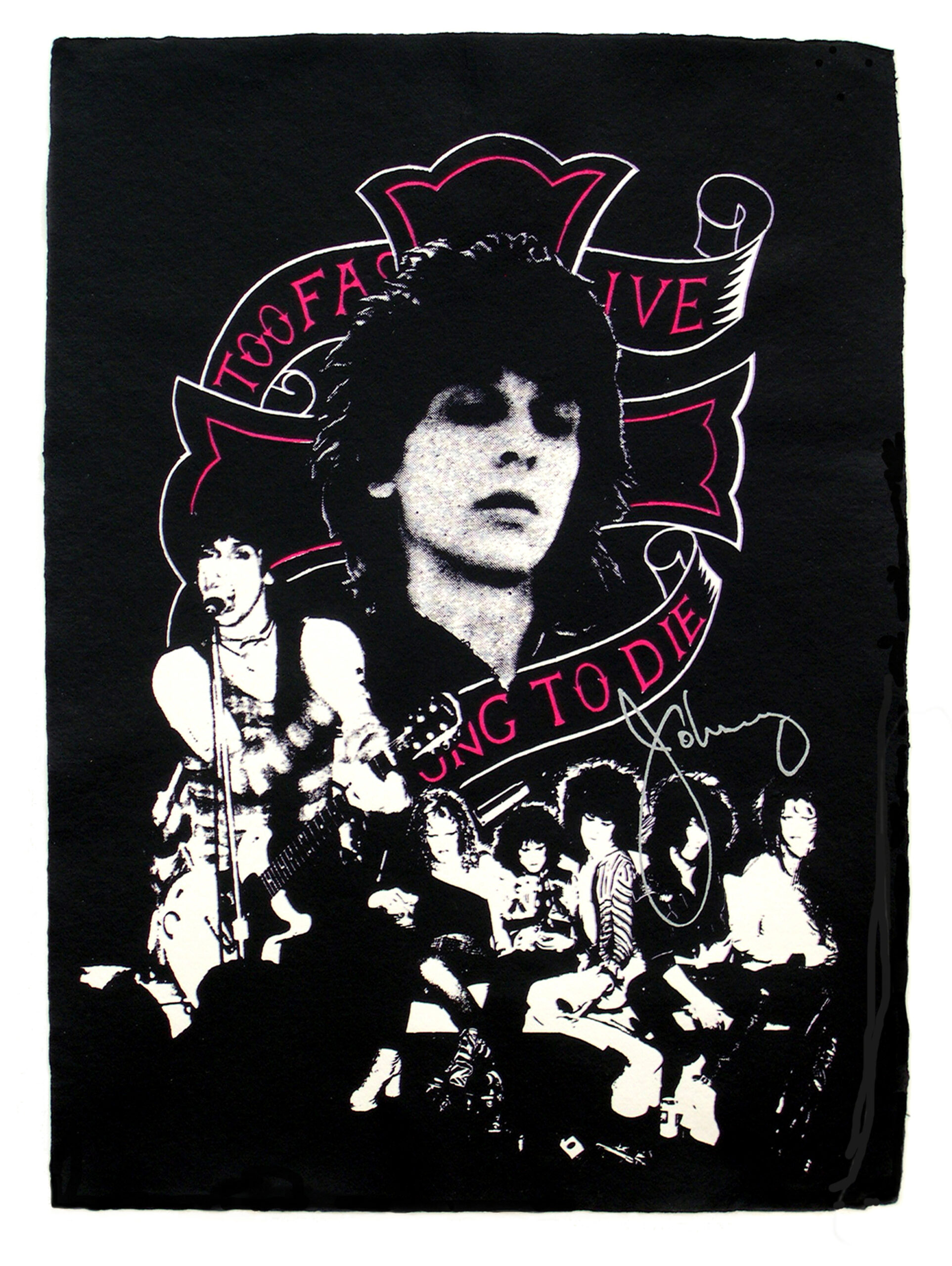
Johnny Thunders (Rebel No.6), 2010
Screen print on hand-made rag paper,
signed and numbered on verso.
Edition of 24.
77 x 56 cm
30.3 x 22 in
Edition of 24
Exhibition
2007 John Dove & Molly White Prints and T-shirts. The Aquarium Gallery, London.
2007 Paradise Garage Massacre, Aquarium Gallery, London.
2012 Face To Face, Paul Stolper Gallery, London
Literature
1980 BOY Blackmail, Dove/White, Flash Publishing
Collection
The Damien Hirst Collection
Johnny Thunders was the hottest Rock’n’Roll guitarist throughout the 70’s and the main inspiration for Steve Jones. In 1972 The New York Dolls toured Europe and supported Rod Stewart at Wembley in October. The Dolls disbanded late in ‘73 after their infamous ‘Better Red than Dead” tour. Thunders continued as a solo Artist and played his heart out till he died in 1991. “In 1978, we closed our West-end store Kitsch-22, and ceased trading for some months while we concentrated on a new collection of T-shirt designs. JOHNNY THUNDERS was one of the strongest designs in the Rebel series, made from a mixture of mass media photographs cut up and scanned onto film. The films were then chopped and painted into the design with a solid black background. The effect was the same as a discharge print where the design appeared to have evolved from the black cloth. We continued to print flat T-shirt front panels pinned down on the print-table with loads of paste to saturate the cloth with a good black leaving the light areas for colour when the black had dried out. After many years printing this way, registration of colours became almost automatic, after the first ten prints you could hit the image first time without adjustment. Later we imported one of the first 8-colour carousel t-shirt printing machines from Italy. We needed to hire some guys to man the machine. Our dyes were too primitive for automation – the drying times were slow. We didn’t want to change to spirit based inks so we sold the machine to a T-shirt printer starting up. Today we continue to work on the print table without any mechanised process. In 1984, Johnny Thunders visited our studio to collect his Rebel T-shirt. His manager was talkin’ about royalties but Johnny wasn’t interested – he applauded our total passion with Rock’n’Roll T-shirts and was delighted to be included in our Rebel Collection”. As loyal Fans, we made him a Black on Black printed Snakeskin suit for his tour. In 2007 the Aquarium Gallery commissioned Dove and White to publish the Rebel and Face collections from the original screens. The T-shirts were hand-printed and made entirely in their studio. They were published in a limited edition of 46 – each numbered with a certificate and signed. The accompanying photographs were from their BOY BLACKMAIL catalogue designed in 1980. The photographers were Sheila Rock, Angelo Sotiriou and Derek Hutchins. The print remains in the Dove and White collection at the Paul Stolper Gallery.JOHN DOVE and MOLLY WHITE.
REBEL No.8 (WAYNE COUNTY)
T-SHIRT 1978
Screen-print on white cotton jersey with black back/sleeves.
Made for Kitsch-22, 22 Woodstock St. London
Exhibition
2007 John Dove & Molly White Prints and T-shirts. The Aquarium Gallery, London.
2007 Paradise Garage Massacre, Aquarium Gallery, London.
2016 Pop Art Fabrics And Fashion, Textielmuseum Tilburg, Netherlands
Literature
1980 BOY Blackmail, Dove/White, Flash Publishing
1988 The T-Shirt Book by Alice Hiller and John Gordon, Ebury Press, London
Collection
The Damien Hirst Collection
The Victoria & Albert Museum
JAYNE COUNTY first broke as a New York Transsexual in 1972 after she moved from Dallas, Georgia in 1968. New York was the cultural hub for American transsexual Artists like Candy Darling. Jayne, formally known as Wayne, was with in ‘75 with The Backstreet Boys and whipped up a media storm. Jayne also wrote her autobiography, “Man Enough To Be A Woman. It was launched in London in 1982 We met her briefly at a Punk concert in the 80’s when she was with the Electric Chairs and dressed as Wayne.
WAYNE was No. 7 in the Rebel series, made from a mixture of mass media photographs cut up and scanned onto film. The films were then chopped and painted into the design with a solid black background so the effect was the same as a discharge print – the design appeared to have evolved from the black cloth. We continued to print flat T-shirt front panels pinned down on the print-table with loads of paste to saturate the cloth with a good black leaving the light areas for colour when the black had dried out. After many years printing this way, registration of colours became almost automatic, after the first ten prints you could hit the image first time without adjustment. Later we imported one of the first carousel 8-colour t-shirt printing machines from Italy. We needed to hire some guys to man the machine. Our dyes were too primitive for automation – the drying times were slow. We didn’t want to change to spirit based inks so we sold the machine to a T-shirt printer starting up. Today we continue to work on the print table without any mechanised process. In 2007 the Aquarium Gallery commissioned Dove and White to publish the Rebel and Face collections from the original screens. The T-shirts were hand-printed and made entirely in their studio. They were published in a limited edition of 46 – each numbered with a certificate and signed. The accompanying photographs were from their BOY BLACKMAIL catalogue they designed in 1980. The photographers were Sheila Rock, Angelo Sotiriou and Derek Hutchins.In 1966 Elvis would be an inspiration for our Wonder Workshop T-shirts of the 60’s. We also began to make an ELVIS montage from all kinds of sources stuck down onto a sheet of plywood. We made a wooden frame and later used rhinestones around the edges with a stained-glass “KING” at the top. As we accumulated more images we would stick them over the existing photographs until we were certain there were no more better options.
In our younger days when Rock’N’Roll came to the UK from the US, it was like revolution. It gave young people an identity outside of the dull austerity that had remained after the second world war. There was a reason to Dance! Imagine – this young white singer, brash, handsome, parading in a pink suit – wears make-up and drives a Cadillac. In the spring of 1954 Elvis Presley first performed at the Memphis State College’s Student Association that were sponsoring a blood-bank drive and needed an entertainer! The news was out – the crowd gathered during the 90 minute gig until the auditorium was packed out – Elvis was a sensation. ELVIS is different in every way to the Memphis country singer, he is casual, soft-spoken, romantic but when he sings to a Rock’N’Roll beat – he shakes like an entranced animal. The girls go wild.
His first record is released on 8th. June in 1954. Memphis DJ Dewey Phillips played ELVIS on the radio for the first time and power-played “Thats All Right”. The WHBQ switchboard was blocked immediately with requests. Who is this guy – is he black? Although more than one racist critic wrote up his performance as ‘the kind of animalism that should be confined to dives and bordellos’, ELVIS WAS READY. “That’s All Right” was written by the great Arthur Crudup, an African American blues Artist who wrote more than a hundred songs including “My Baby Left Me”, “Too Much Competition” and “Rock Me Mama”. Elvis Presley died in 1977 when we were running Kitsch-22.